 Its our.in | India's Pride

India’s EdTech sector continues to expand at scale, driven by a massive learner base, digital adoption, and growing demand for upskilling.
By 2026, the market is not only large but structurally important, with millions of learners relying on digital platforms for education, training, and career advancement.
But behind every EdTech company lies a foundational decision that rarely gets discussed in depth:
the domain name.
This article looks at the top 20 EdTech companies in India in 2026 and the domains they operate on, and more importantly, what those choices reveal about the market.
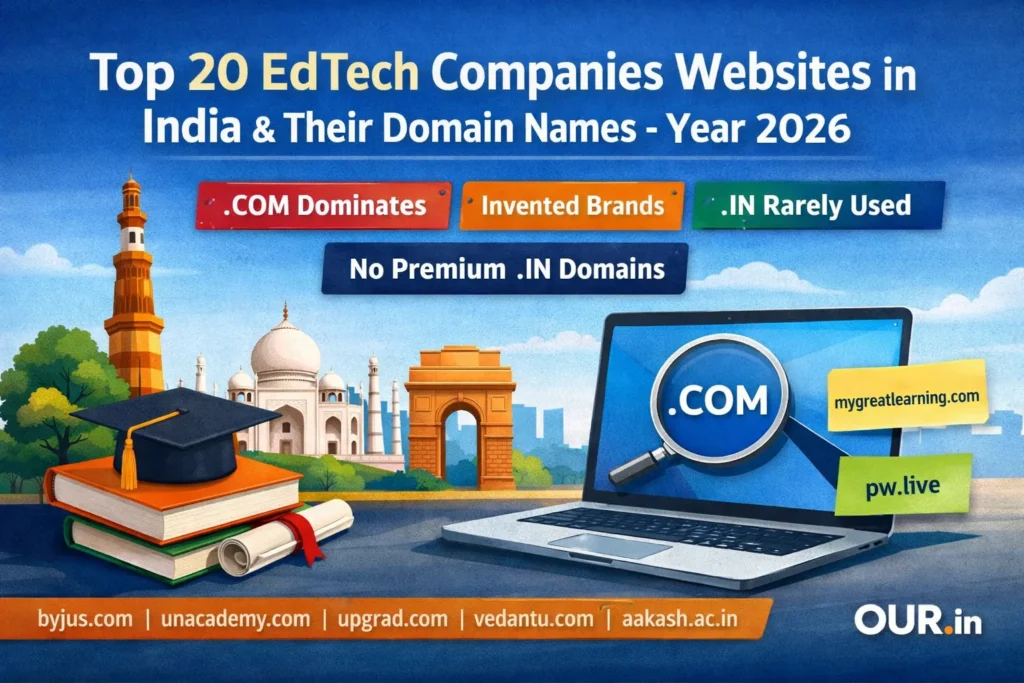
Top 20 EdTech Companies in India (2026) with Domains
Core Market Leaders
- BYJU’S – byjus.com
- Unacademy – unacademy.com
- upGrad – upgrad.com
- Vedantu – vedantu.com
- Physics Wallah – pw.live
- Simplilearn – simplilearn.com
Test Prep and K12 Platforms
- Adda247 – adda247.com
- Toppr – toppr.com
- Aakash Institute – aakash.ac.in
- Allen Digital – allendigital.in
- Extramarks – extramarks.com
- Embibe – embibe.com
Upskilling and Higher Education
- Great Learning – mygreatlearning.com
- Eruditus – eruditus.com
- Imarticus Learning – imarticus.org
- NIIT – niit.com
New Age and Platform-Based EdTech
- Classplus – classplusapp.com
- Teachmint – teachmint.com
- Leverage Edu – leverageedu.com
- Cuemath – cuemath.com
What Domain Choices Reveal About the Market
A clear pattern emerges when these companies are viewed collectively.
1. .COM Dominates Almost Completely
The overwhelming majority of leading EdTech companies operate on .com domains.
This includes:
- byjus.com
- unacademy.com
- upgrad.com
- vedantu.com
- simplilearn.com
Even companies that are entirely focused on India continue to choose .com as their primary digital identity.
2. Invented Brand Names Are the Norm
Very few companies use dictionary words.
Instead, most rely on constructed or modified names such as:
- Unacademy
- upGrad
- Vedantu
- Cuemath
These are not accidental choices. They are driven by availability and speed rather than long-term brand clarity.
3. .IN Usage Is Minimal
Among the top 20, .IN usage is almost non-existent as a primary brand.
The only notable example:
Allen Digital – allendigital.in
Even this is an extension of an existing offline brand rather than a digital-first naming decision.
4. Institutional Domains Follow a Different System
Entities like Aakash operate on:
aakash.ac.in
This reflects regulatory alignment rather than branding preference.
It is important to distinguish between:
institutional identity and commercial brand identity
5. When .COM Is Not Available, Short Alternatives Are Used
Physics Wallah operates on:
pw.live
This reinforces an important pattern:
When .com is unavailable, companies prefer short, brand-driven alternatives rather than switching to .IN.
What Is Missing Completely
Across all top 20 companies, one thing is clearly absent:
premium, single-word, category-defining domains
There are no companies operating on domains such as:
- learning.in
- courses.in
- skills.in
- academy.in
There are also no simple, universally understood brand words such as:
- pear.in
- mango.in
Why This Matters
This is not a coincidence. It reflects how the market currently behaves.
Most EdTech companies:
- launch quickly
- prioritise availability
- choose what is immediately accessible
They do not optimise for:
- long-term brand recall
- category ownership
- linguistic simplicity
A Market Driven by Speed, Not Naming Strategy
The data shows that domain decisions are largely driven by:
- availability
- speed to launch
- default industry behaviour
Rather than:
- strategic brand positioning
- long-term identity value
This explains why names like:
- mygreatlearning.com
- classplusapp.com
continue to exist even at scale.
The Structural Gap in the Market
Despite India having one of the largest learner populations in the world, there is:
- no dominant category domain
- no widely adopted premium .IN brand
- no ownership of core education keywords
This creates a clear structural gap.
Final Observation
India’s top EdTech companies in 2026 are not built on the strongest possible domain assets.
They are built on:
- available names
- functional branding
- execution-driven growth
Closing Thought
Startups choose what is available.
Market leaders eventually realise what is valuable.
The Indian EdTech ecosystem has reached scale.
The next phase will determine who owns not just the market, but the identity of the market itself.
